


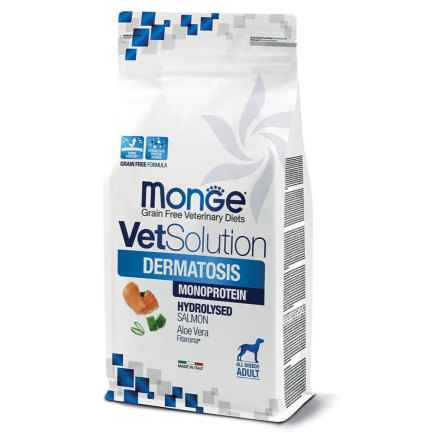
Monge Vetsolution Dermatosis kibble for sensitive dogs is formulated with fish protein hydrolysate that limits food allergies and intestinal workload.
It contains inoltro Aloe vera that enhances collagen synthesis by strengthening the dermal barrier.
Monge Vetsolution Dermatosis veterinary kibble for dogs contains SOD (Super Oxide Dismutase) to prevent oxidative stress, XOS (Xylo-oligosaccharides) to preserve the gut microbiota, and is coated with a functional Fit-aroma (Aloe vera) that provides a healthy and tasty approach to skin disorders.
Indications
Inflammatory skin diseases, food allergies, food intolerances, chronic itching, inflammatory bowel disease, pancreatic insufficiency, and chronic diarrhea.
Contraindications
Pancreatitis, hyperlipidemia.
CHARACTERISTICS OF MONGE VETSOLUTION DERMATOSIS FOR DOGS
PROTEIN: The only animal protein source is Norwegian salmon hydrolysate, with a low molecular weight, which can limit the intestinal allergen load and ensures optimal digestibility. The salmon protein in Monge VetSolution Dermatosis for Dogs is predigested by enzymes improving nutrient bioavailability and increasing the action of bioactive substances. Norwegian salmon protein hydrolysate is rich in anserine, which exhibits metallo-chelating properties, antagonistic activity against free radicals and tissue-stabilizing action. The palatability of Norwegian salmon hydrolysates and nucleotides ensures optimal feed intake.
ESSENTIAL FATTY ACIDS: Monge VetSolution Dermatosis for dogs contains purified salmon oil, a source of Ω3 fatty acids; the final Ω6/Ω3 ratio is maximum 5, with a total EPA and DHA concentration of at least 0.46%.
Complete dry food for adult dogs
Composition
Hydrolyzed salmon protein (23%), dehydrated peas (18%), tapioca, potatoes, fat
animal (duck oil)*, pea fiber, animal fat (chicken oil)*, fish oil
(salmon oil)*, carob powder, mineral salts, brewer's yeast, Xylo-oligosaccharides
(XOS 0.4%), Aloe vera (0.06%), freeze-dried melon juice concentrate (0.005%
- Cucumis melo cantalupensis - source of Super Oxide Dismutase).
*purified to 99.6% and preserved with natural antioxidants.
Analytical constituents
Crude protein: 23% - Crude fiber: 7% - Crude oils and fats: 17% - Crude ash:
6.3% - n-3 fatty acids: 0.84% - n-6 fatty acids: 4.35%
Additives/kg
NUTRITIONAL ADDITIVES:
Vitamin A: 25.000 IU - Vitamin D3: 1,500 IU - E1 (Iron): 165 mg - E2 (Iodine): 2
mg - E4 (Copper): 13 mg - E5 (Manganese): 30 mg - E6 (Zinc): 145 mg - E8 (Selenium):
0.45 mg. L-carnitine: 200 mg.
TECHNOLOGY ADDITIVES:
Tocopherol-rich extract of natural origin (Rosmarinus officinalis L.)
It is recommended to seek veterinary advice before use and before extending the period of use. Recommended period of use up to 2 months. The recommended daily dose in grams
is given in the table, to be divided into two meals. Fresh, clean water should be available at all times.
Fit-aroma®: Aloe vera
DERMATOSIS
Adult dog weight (in kg) 5 7 9 11 13 15 17 19 21 25 30 40
Recommended ration (g/day)
Underweight dog 110 145 175 205 230 255 280 305 330 375 430 535
Normal-weight dog 100 125 150 175 200 225 245 265 285 325 375 465
Overweight dog 85 110 130 155 175 195 215 230 250 285 325 405
ALOE VERA.
Monge VetSolution Dermatosis Fit-aroma® for dogs contains Aloe vera, with a minimum concentration of 95% mannanoligosaccharides.
Glucomannans are absorbed, not digested, and appear in the bloodstream in exactly the same form in which they were introduced.
The high polysaccharide content ofAloe vera limits inflammatory processes, strengthens the immune system, and reduces the accumulation of body fat by stimulating energy expenditure.
Aloe vera extract is scientifically proven to have collagen regenerative properties and improve skin elasticity; therefore, Aloe vera accelerates the repair of micro-injuries and ensures the strength of the dermis.
The activity of free radical antagonists contained inAloe vera, could be useful in counteracting an increase in oxidative stress observed in animals with atopic dermatitis.
Some of these polysaccharides are not absorbed but attach to cells in the intestinal wall.
They help to provide an additional barrier by strengthening cell junctions and preventing the "permeable" gut-induced inflammatory syndrome implicated in the mechanism of food allergies.
